“They advertised it all over town that they expected to block traffic and do civil disobedience type of things.”
Michael Chitwood, Portland Police Chief
On the occasion of the 10th anniversary of the death of ACT UP activist Michael Bellefountaine, let’s take a look back to his formative years as a direct action activist. Hailing from rural Maine, Michael was among the first generation of queers who came out in the early shadow of ACT UP’s militant approach to fighting AIDS. The organization just celebrated the 30th anniversary of its first demonstration in April, 1987.
Michael Bellefountaine is carried away by police in an ACT UP Maine protest against AIDS and the Iraq War, Jan. 23, 1991.
It was a much different time back then to be out, loud and proud; one that required a hefty amount of courage and perseverance. By 1989 Michael was traveling to Boston and New York by bus to participate in meetings and actions where he learned the basics of a new movement in AIDS activism that was as informed as it was confrontational.
In the summer of 1990 he was one of the co-founders of ACT UP Maine along with C.T. Butler. Butler was also one of the founders of Food Not Bombs whose use of consensus for group process and decision making became a core of Bellefountaine’s involvement with ACT UP and other direct action movements such as animal rights.
AIDS activist Michael Bellefountaine marches in Portland, Maine’s gay pride march circa 1990.
Among the dozens of boxes in the ACT UP Archives still to be processed, there is one with Michael’s material of activism which predates his arrival in San Francisco, with David Pasquarelli, at the end of 1993. For several months I’ve been digitizing a small binder of photocopies from ACT UP Maine’s first action in the summer of 1990 until Michael’s move to Florida in 1992.
Bangor Daily News, October 12, 1991, page 7
Now that those photocopies and a couple of darkening news clippings have been scanned, I’ll begin highlighting selections from the news coverage of ACT UP Maine. For many years ACT UP SF’s detractors attempted to delegitimize the radical dissident chapter in the tiresome gay political parlor game of whose right it is to use that five letter acronym.
These documents help illustrate the foundation of Michael Bellefountaine’s fifteen years of ACT UP activism which came from direct participation in the actions and demonstrations of the its original East Coast roots, with a strong emphasis on people with AIDS and HIV living in rural communities.
Casco Bay Weekly, Sept. 5, 1991, page 8
Though it began in the waining years of the Regean administration, ACT UP came into its own during the Presidency of George H.W. Bush. Among the group’s most celebrated actions was the Day of Desperation on January 23, 1991– coordinated protest against Bush’s Persian Gulf War and the perpetuation of armed conflict in the Middle East.
ACT UP Maine also took the streets that morning as the war approached six months of death and environmental destruction in the Persian Gulf. Like many rural chapters, ACT UP Maine harnessed the national protests to call attention to local issues affecting people with AIDS and HIV.
Ultimately 10 members of the group were arrested for blocking traffic in downtown Portland. 6 men and 4 women lay down across Congress Street at Monument Square during a lunch hour march and rally. The choice of location maximized exposure to ACT UP Maine’s message challenging the government’s misdirection of priorities and funding.
Speakers blamed leaders from both the state and the nation for creating a mood of public apathy and indifference. Their demands included AIDS specific clinics and that doctor’s ensure care for patients without insurance.
Portland Evening Express, Jan. 24, 1991
The best coverage of the demo came from the Jan. 24, 1991 Portland Press Herald which featured a pair of eye-catching photos including the iconic image of Bellefountaine being dragged off by Portland Police officers. Tat striking photograph was picked up by wire news services and reprinted across the nation.
Portland Press Herald, Jan. 24, 1991, page 1D
The best quote came from Portland Police Chief Michael Chitwood, “They advertised it all over town that they expected to block traffic and do civil disobedience type of things.” The “advertisements” were likely flyers wheat pasted around town encouraging citizens to participate while informing them of the reasons for the scheduled protest.
After speeches, ACT UP Maine activists ignited flares atop placards as 10 participants darted into the street and laid on their backs until they were forcibly removed by law enforcement. Charged with misdemeanor citations for obstructing a public way, the activists were transported to the Cumberland County Jail.
Portland Press Herald, Jan. 24, 1991, page 1D
“At the jail, the protestors refused to identify themselves. Instead, they gave the names of public figures that ACT UP regards as adversaries, among them U.S. Sen. Jesse Helms, state Human Services Commissioner Rollin Ives and Jasper Wyman of the Maine Christian Civic League.”
During the demonstration, participants carried tombstone shaped signs and pushed homemade black wooden coffins. In messages to the media, activists took aim at the nation’s misplaced sense of urgency, highlighting the discrepancy of resources between the Persian Gulf War and AIDS War. As speaker Patrick Dunn stated, “Because of the war in the Persian Gulf, it’s been easy to put this war aside…This was hasn’t ended. We’ve been fighting this war 11 years.”
As our country continues its destructive journey on the bloody path of endless war, it’s the legacy of direct action activists like Michael Bellefountaine whose 15 year commitment to ACT UP’s struggle for justice and dignity for people with AIDS and the still unfulfilled promise of queer liberation that provides perspective and inspiration to continue the persistence of resistance.
It’s a happy coincidence the occasion of what would have been the 50th birthday of ACT UP San Francisco activist Michael Bellefountaine coincides with the ebook release of his book A Lavender Look at the Temple: A Gay Perspective of the Peoples Temple. Last year’s birthday post recalled Michael’s formative days as an AIDS activist by looking at his participation in ACT UP Maine during the Bush presidency of the early 1990s.
AIDS activist Michael Bellefountaine marches in Portland, Maine’s gay pride march circa 1990.
During the last years of his life, Michael was enrolled in the history department at San Francisco State University. There he involved himself in a number of projects that included documenting the stories of those buried at Mission Dolores. For many years he had become interested in the Peoples Temple.
Known mostly for the 1978 mass suicide of its members who had exiled themselves to the jungles of Guyana, Jim Jones and the Peoples Temple had been an undeniable influence on the progressive agenda that defined San Francisco politics of the 1970s from George Moscone to Willie Brown.
As Michael began to research the Peoples Temple story beyond the horrific and histrionic headlines that dominated media representation, he was surprised to learn of an ongoing connection to Harvey Milk.
Frustrated with the dismissive treatment of the subject by Randy Shilts in his biography The Mayor of Castro Street, which had Harvey describing Temple members as “weird” and “dangerous”, Michael decided to dig deeper into the story especially after he discovered an extensive involvement of gays and lesbians within the Peoples Temple.
Harvey Milk in front of his Castro Street Camera Store, circa 1977, photo by Dan Nicoletta.
He interviewed associates of Harvey Milk, such as photographer Daniel Nicoletta, and connected with The Jonestown Project whose website states “its primary purpose is to present information about Peoples Temple as accurately and objectively as possible. In an effort to be impartial, we offer many diverse views and opinions about the Temple and the events in Jonestown.”
Michael’s intended to write a full length work but was unable to complete the book before his untimely death in 2007. Thanks to the tireless effort of his mother Dora, his book was self-published in 2011 in both paper and hardback editions. A Lavender Look at the Temple can now be purchased as an ebook at this link.
A quote from an online review of Michael’s book:
The book also examines how gay, lesbian, bisexual and transgender Peoples Temple members faired in their community during a hostile time in history.
In the last years of his short life, the author, Michael Bellefontaine, was a staunch gay rights and AIDS activist in San Francisco, California but he was also part of the Peoples Temple and Jonestown history.
While other writers have long dismissed Milk’s relationship with the Peoples Temple, Bellefontaine not only addresses it but attacks and analyzes the information from reliable sources regarding their association.
First, you have to understand the lure of the Peoples Temple. It was welcoming of people from all walks of life including races, genders, ethnicities, sexual orientation, and religions. Rev. Jim Jones was charismatic and fooled people into believing that he had special powers to read minds and cure people. But it wasn’t just Jim Jones that lured it’s members.
The People Temple offered services such as drug and alcohol rehablitation; a food pantry and soup kitchen; counseling; a school; elder care and day centers; and other facilities widely staffed and run by it’s members. The Peoples Temple welcomed people of all walks of life including the ostracized, the outcasts, criminals, etc. into their world.
Michael’s talent as a writer comes not only from his thorough and thoughtful research but also his skill at relaying the personal experience of gay and lesbian Temple members through a gripping narrative. In fact, Michael’s research was included by San Francisco journalist David Talbot in Season of the Witch: Enchantment, Terror and Deliverance in the City of Love, Talbot’s book about the city during the 1970s and 1980s.
While it’s unfortunate Michael wasn’t able to further develop his research on the Peoples Temple (not to mention the other areas he would have explored as a historian and researcher) we can remain grateful his mother Dora made sure that this brief but potent document is preserved and available. Happy 50th Birthday Michael Bellefountaine!
ACT UP member Michael Bellefountaine participating in Critical Mass bike ride in San Francisco, circa 2002.
A personal tribute to my dear friend and ACT UP comrade David Pasquarelli on what would have been his 48th birthday.
I was the last of a generation of gay men who came out in ACT UP – the AIDS Coalition to Unleash Power. My arrival at ACT UP San Francisco, in late January 1994, was a good year after the group’s peak which had quickly dwindled following the election of Democratic President Bill Clinton. It was the decade and a half of oppressive Republican policies that fueled the furnace which fired ACT UP’s anger and rage.
By the time I walked into the Women’s Building in the Mission District, there remained only a few members of the old guard that existed as an ersatz support group, a shell of the former political activism that had sharpened the city’s progressive political agenda into a queer militant force. Though they still believed in ACT UP’s mission, the handful of queers that maintained Thursday night General Body meetings were beleaguered from years of care giving for dying loved ones and the entrenched activism against a system that would not yield to its pressure. The meetings had a sparse, ghostly feeling that was distrustful of new energy, as if it were too sharp a reminder of the power of bodies in the street, out, loud and proud, were now ash, murdered by church and state.
At the time, I was oblivious to all that battle history. I had moved to San Francisco the previous summer with my older brother to attend San Francisco State. We lived in a cozy apartment near the end of the city at Park Merced, adjoining Lake Merced and the Pacific Ocean; yet I yearned to be part of the gay community – in the action. I was not among the underage fags who ventured out to parks for sexcapades or danced the night away in drug-fueled clubs. Growing up in conservative, repressed Orange County of the 1980s, I was too fragile, my recklessness more intellectual than physical. If I were to drive the many freeways that lead to Los Angeles, my time was spent at art house cinemas or bookstores.
David Pasquarelli protesting at the 1992 Republican convention in Houston, Texas.
I had turned 21 determined not to celebrate the occasion with my first visit to a gay bar. AIDS hijacked my adolescence when I was 11 with media broadcasts of plague terror and the moral retribution of the church’s wrath. God was righting man’s wrong. Alone and afraid, I tried my best to make sense of the senseless with a child’s mind that, as Patti Smith sang, “saw everything just a little bit too clearly.” By my late teens, I was reading books by Larry Kramer and Randy Shilts, subscribing to The Advocate and The Village Voice. Fighting AIDS was about staying informed; knowledge was power. The promise of Harvey Milk still seemed possible despite the deepening horror of Republican, Christian domination.
ACT UP was the fulfillment of that promise to end AIDS and bring about gay liberation. This was time when the Berlin Wall fell and apartheid ended in South Africa, when the future was malleable. I wanted to be part of the movement to end AIDS. This was our time in history and ACT UP was the vehicle, continuing the lineage of coalition-based movements from civil rights to the protest against Vietnam. There was such a depth of anger and rage that I had somehow kept from consuming me. ACT UP was the repository for that fire, my contribution to the cause.
When I walked into my first ACT UP meeting, I had naively expected to sit in the back of a room of filled with dedicated, vibrant activists, maybe chatted up by some welcoming drag queen. Instead there were eight people whose look ranged from punk to goth to hippie to elder lesbian. Reactively, I felt I had make a mistake coming and considered returning to the familiarity of my bedroom with its records and poetry books.
A typical Saturday morning at Harvey Milk Plaza in the mid 1990s.
Then Michael Bellefountaine walked over, shaking my hand as he introduced himself. “I’m Mike Bellefountaine and I want to give you some information about something we’ll be talking about tonight- the AIDS Cure Act.” I was so relieved someone had broken the ice that my insides began to unwind as I relaxed more into the evening. I had read about the AIDS Cure Act in Larry Kramer’s column in The Advocate. Frustrated by the inaction of researchers and the government’s response to AIDS, ACT UP had taken on Bill Clinton’s campaign promise to create an all encompassing research program, like the Manhattan Project, to cure AIDS.
The AIDS Cure Act, among other things, sought to consolidate research, connect scientists with patients, and challenge pharmaceutical greed. Whatever treatment it developed would be available to people regardless of their ability to pay. Later in the meeting, Michael’s friend, David Pasquarelli, spoke about what they were doing to enact this piece of federal legislation. At one point he held up a mock newspaper headline that exclaimed “AIDS Cure Found.” Rather than hokey, it felt tangible. This was something where I could offer my energy, my spirit, a way to participate that had meaning.
At the end of the meeting David piled me up with packets of information (something that would continue over their next decade of activism) as Michael spoke the words I had longed to hear, “We need your help.” On the long bus ride back to Park Merced, I poured over the handouts, flyers and copies of news articles. I supplemented my regular attendance at General Body meetings with added Wednesday evenings at the AIDS Cure Act working group, which met at Mission Grounds coffee shop on 16th Street at Albion.
It was there I got to know Michael who was in his late 20s yet retained a baby faced chubbiness he never outgrew. Wearing tan hiking boots, jeans that seemed to always sag at the ankles, and a too big sweater, his curly headed hair was perpetually crowned with a backwards baseball cap from the café St. Louis, in Sarasota, Florida, where he waited tables. Though originally from rural Maine, with the accent to prove it, Michael had met David while living near the white sand beaches of the Gulf Coast.
A criminally young & positively gay David Pasquarelli
It had only been two months since his friend David Pasquarelli had shown up one night at Michael’s apartment in his convertible Jeep with a tiny trailer attached to the back containing all of David’s possessions. Two years of rural activism in Florida had proven to David that the gay political leaders, wedded to Democratic Party control, would only continue to drain their sense of urgency to fight AIDS. If you wanted to be serious about fighting AIDS (to “be real” as they say these days) you went to San Francisco.
Within the time it took Michael to pace around his apartment smoking a joint, all his possessions, including his cats Mickey and Iko, were crammed into the trailer. David was a huge fan of the Pet Shop Boys, whose cover of the Village People’s gay anthem “Go West” had topped the U.S. dance charts that summer. They played it continually as their theme song as they set out across America.
David Pasquarelli confronting Christian ladies during his time with ACT UP Tampa Bay in the early 1990s.
David Pasquarelli was an undeniably beautiful gay man. Razor thin with a shaved head, piercing blue eyes and a smile so bright it lit up everyone around, David was gorgeous. Even his detractors admitted as much. He wore the look of the time: Black combat boots, extra large camouflage pants sheared above the knees held up with a studded leather belt, over his skinny chest was a concert t-shirt (Erasure or Skinny Puppy) worn on top of a white thermal shirt whose long sleeves were pushed above the elbows, all of it topped off with the de rigueur black leather jacket that was just bit too large in the style of Grace Jones.
It was after a few weeks of meeting, sometime in late February when the boys invited me back to their apartment after a working group meeting to continue strategizing, organizing. Though I had begun to feel a previously unknown ascendancy to my recent participation in ACT UP, a clarity of purpose that swept away hesitation, it remained purely intellectual, lacking the ability to connect on a cultural, fraternal level. It was the crucial difference between saying you’re an out gay man and living as an out gay man.
David Pasquarelli, co-founder of ACT UP Tampa Bay
Heading out from the Mission District to their place on Waller Street, an entrenched self-doubt that is the pernicious core of homophobia persisted. The fear of failure is so interminable that you’re convinced it is safer not to try, to remain hidden. But I was so sick of the old ways that I knew the only answer to be found was out on the streets, with other queers as pissed off as me.
As we walked the nighttime streets to the Lower Haight, my mind echoed with a familiar refrain from the song “How Soon Is Now?” by the Manchester group The Smiths. It’s one of the truly classic songs of any era, a perfect melding of guitarist Johnny Marr’s voodoo laden backing track with lyricist Morrissey’s plaintive lament to “a shyness that is criminally vulgar.” His voice is archly mournful, veering on the edge of camp, yet never losing a sense of compassion. Veering off Church Street towards Fillmore, I kept thinking, “If only there were some sort of confirmation, a sign to let me know I was on the right path.”
As I climbed the stairs leading up to Michael and David’s second story flat, my inner voice continued its broadcast of discouragement that the doubt would always linger. Their apartment was really a one-bedroom set up to house the pair of them. From the stairs, I entered into the living room, just off the kitchen, which was David’s bedroom. The walls were plastered with large posters from British music groups like Dead Can Dance and Everything But The Girl but it was a poster for The Smiths single “The Boy With The Thorn In His Side” that I first saw. It was impossible to miss due to its gigantic size, designed for flyposting on billboards.
The record cover, designed by Morrissey, featured exhibitionist author Truman Capote leaping through the air as he was photographed in Tangier by British photographer Cecil Beaton in 1949, the entire image washed with pale yellow. Truman’s shirt is tied exotically at the waist, his mouth spread wide with irrepressible glee. It remains one of the gayest images ever, perfect for Morrissey’s autobiographical lyrics about a boy, behind whose “hatred there lies/a plundering desire for love.”
Cecil Beaton & Truman Capote in pose
On this song, perhaps The Smiths most definitive, Johnny Marr’s accompaniment is brightly playful with the sound of a marimba adding a light Caribbean touch. Morrissey’s lyrics were the lyrical prophecy that I had been seeking,
And when you want to live
How do you start?
Where do you go?
Who do you need to know?
The stars aligned and any remaining confusion was finally extinguished by larger than life Truman as he looked down from the wall. His eyes seemed to say all would be right if only I took the leap, like Nijinsky, spreading my arms and legs out into the air in celebration of all that is fabulous, outrageous and so queer it’s gay. It was that moment when I knew, no matter how challenging and adversarial the fight might become, that I was indeed on the right track.
Michael Bellefountaine with unidentified queer activists in Maine, early 1990s.
In honor of the outspoken, radical AIDS activist Michael Bellefountaine, who would have turned 49 today, ACT UP Archives is taking a look at some of his formative actions as a member of ACT UP Maine. Growing up gay in the small town of Gorham, in southern Maine, was difficult for Michael yet his rural background informed his activism. While many believed that the sun rose and set on ACT UP New York, Michael consistently strived to ensure that his message resonated with queer communities outside big cities.
Michael Bellefountaine is carried away by police in an ACT UP Maine protest against AIDS and the Iraq War, Jan. 23, 1991.
Michael joined ACT UP in 1989 and cut his teeth on direct action activism traveling by bus to demonstrations in Boston and New York before helping to found a Maine chapter based in Portland. Among ACT UP Maine’s founding members was C.T. Butler who also co-founded Food Not Bombs. It was through his participation with Butler and Tess Ouellette that Michael became well versed in the use of consensus as a process of decision making for activist collectives.
AIDS activist Michael Bellefountaine marches in Portland, Maine’s gay pride march circa 1990.
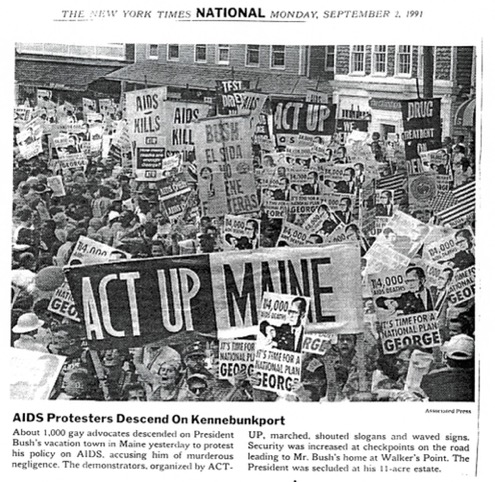
In the summer of 1991, thousands of ACT UP activists descended on the resort town of Kennebunkport where the family of then President George H. W. Bush had a summer home. Bush’s lack of attention to AIDS followed the same bigoted, murderous agenda of his predecessor Ronald Reagan. Michael was involved in the planning of what became one of the most well publicized actions in the history of ACT UP.
The articles and photographs featured in this post are from Michael’s personal archive which contains a wealth of documentation from his decade and a half of impassioned activism whose dynamic and inspirational history will be explored further in future ACT UP Archive posts.